

Actress Olivia Munn, 45, is opening up about the part of a cancer journey that many people don’t fully see: what happens after the biggest, most frightening milestones are over. While the public often focuses on diagnosis announcements, surgery updates, or the final day of treatment, Munn says the reality of rebuilding life afterward can be unexpectedly demanding—physically, mentally, and emotionally.
Speaking during a recent press junket tied to Season 2 of Apple TV+’s Your Friends & Neighbors, Munn discussed the fears and hardships of her experience with an aggressive type of breast cancer, much of which she navigated away from the spotlight. She also shared that words from Catherine, Princess of Wales (Kate Middleton)—shared after Middleton spoke about her own cancer remission—gave her language for a feeling she’d struggled to describe.
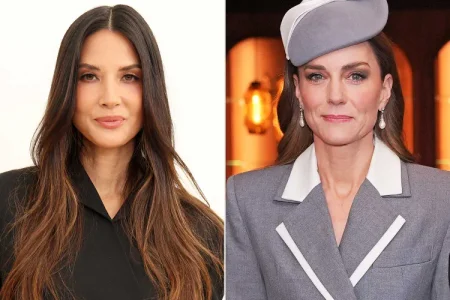
Olivia Munn (left); Kate Middleton. Credit : VALERIE MACON / AFP via Getty; Yui Mok – Pool/Getty
The “after” can be the hardest part to explain
In an exclusive interview with PEOPLE, Munn said Middleton articulated something that resonates with many survivors: you prepare yourself for the “big” events—the scans, the procedures, the brutal weeks of treatment—but it’s often the long stretch afterward that quietly tests you.
Munn explained that Middleton’s remarks struck her because they were so direct and familiar. “You think that the big things are the things you have to worry about,” Munn said, noting she was paraphrasing Middleton, “but it’s the treatment after you’ve gone through the big things that’s really taxing and hard on you.”
For Munn, hearing that sentiment from someone else—especially someone whose life is scrutinized as heavily as the Princess of Wales—was grounding. It helped validate a complicated truth: even when the crisis phase is “over,” your body and mind may still be catching up. Recovery isn’t a switch you flip. It’s a process that often comes with fatigue, fear of recurrence, and the pressure to act “fine” before you actually feel like yourself again.
More Reading: Prince Louis at Easter Service Shows a More Poised and Mature Side
Why Kate Middleton’s message resonated with Olivia Munn
Munn said the impact wasn’t only about recognizing the struggle—it was about finally having words for it. When well-known figures speak plainly about survivorship, it can help others name experiences that are difficult to express, even to close friends or family.
That matters because the post-treatment period can be isolating in a unique way. During treatment, support tends to be visible: appointments are scheduled, meals are dropped off, check-in messages arrive regularly. Once treatment ends, the world often assumes the story has a neat, celebratory ending. But many survivors report feeling like they’re expected to “bounce back” quickly, even as they’re still dealing with pain, exhaustion, anxiety, or changes to their identity and routines.
Munn’s reaction to Middleton’s reflections highlights how powerful simple recognition can be. Sometimes what a survivor needs most is not a grand speech, but the reassurance that someone else understands the strange in-between space: being grateful to be alive while also feeling depleted, worried, or emotionally raw.
“You feel so much better when you know you’re not alone”
In the same PEOPLE conversation, Munn emphasized the comfort that comes from shared experience. “That’s where it feels really good,” she said, referencing the relief of hearing other people describe similar emotions. “Because it is true—you feel so much better when you know you’re not alone.”
It’s a point that extends beyond celebrity. Cancer can reshape relationships, work life, and self-image. Survivors may look healthy on the outside while managing invisible side effects, follow-up appointments, and ongoing stress. When public figures speak openly (without turning their health into a performance), it can normalize the reality that recovery is not always linear—and that mixed emotions are common, not shameful.
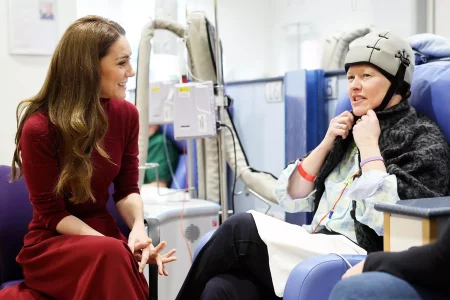
Kate Middleton (left) with a patient at Royal Marsden Hospital on Jan. 14, 2025.
Credit: Chris Jackson/Getty
Public scrutiny vs. private reality
Both Munn and Middleton have experienced public attention in very different forms, but the intersection is telling: even sincere, carefully worded reflections can become a target for online debate. Munn’s comments suggest that the value of these messages isn’t measured by how loudly critics react, but by how deeply they land with people who need them.
For many women and families affected by cancer, hearing someone in a highly visible role speak with calm honesty can be stabilizing. It can also encourage others to share their own stories, seek support, or feel less pressure to “perform” strength every day.
What survivorship can look like: strength, fatigue, and rebuilding
Munn’s perspective underscores an important cultural gap: society celebrates survival, but doesn’t always make room for the messy middle of survivorship. The months after treatment can involve learning new limits, navigating body changes, and managing fears that can be triggered by routine scans or physical sensations.
At the same time, many survivors describe a renewed sense of gratitude and clarity—often alongside lingering vulnerability. That combination can be confusing to process, which is why Munn’s emphasis on community—hearing others, feeling understood—matters. Support groups, counseling, trusted friends, and survivor networks can all help people rebuild in ways that honor both the relief and the hardship.
Munn’s message ultimately centers on compassion: for oneself, and for others whose recovery doesn’t look like a movie ending. Her reflections also highlight why Middleton’s words carried weight. They weren’t dramatic. They were human—and that’s often what reaches people most.
A note on health information
This article is for informational purposes only and does not provide medical advice. If you have concerns about breast cancer, treatment, or recovery, consult a qualified healthcare professional.
Note: This article is for informational purposes only and is not medical advice. Consult your doctor.
Source: People Magazine
Also More: King Charles in Grandpa Mode with Princess Charlotte at Easter
Thank you for continue reading please don’t forget to share this article with your freinds
SHARE


