

A single black-and-white photograph, a heartbreaking caption, and millions of shares — but does the “Martha Evans” story hold up to scrutiny? Here’s what a closer look reveals.
An Irresistible Story
Every so often, a story travels across social media so fast that no one stops to ask where it actually came from. The tale of “Martha Evans” is one of them.
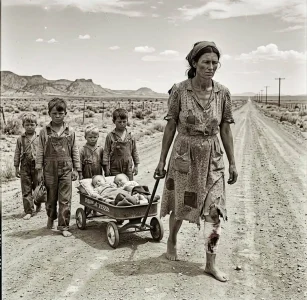
According to the widely shared post, Evans was a 32-year-old mother photographed on July 6, 1936, walking along Route 66 in New Mexico. Her husband had reportedly died of tuberculosis. Her family’s Oklahoma farm had been foreclosed. With nothing but $1.60 in her pocket, she was said to be walking toward California with six young children — pulling 11-month-old twins in a small wagon while her older sons walked beside her.
The story doesn’t stop there. When a government photographer allegedly offered her a ride, she is said to have declined, explaining that accepting help now would only make her children expect it later. The narrative then wraps up with a feel-good ending: the photo made headlines, donations flooded in, the family reached Bakersfield safely, all six children survived, three eventually went to college, and the wagon now sits in the Smithsonian.
It’s a moving story. It’s also, on close inspection, largely fiction.
When a Story Feels Too Well-Constructed
There’s a particular feeling that arises when a narrative lines up too neatly — every emotional beat hit, every historical detail perfectly placed. That instinct is worth listening to.
A closer investigation into the photograph and its backstory turns up no verified, public-domain image that matches the claims. Instead, the viral post appears to be an amalgamation of several unrelated pieces of Depression-era history, stitched together into a single, emotionally engineered narrative.
Untangling the Real History
So where did these details actually come from?
- The mother figure closely echoes Dorothea Lange’s globally famous 1936 photograph Migrant Mother, which depicts Florence Owens Thompson.
- The name and date appear to borrow from a genuine set of Farm Security Administration photographs taken by photographer Arthur Rothstein, documenting a man named Vernon Evans and his family — who were migrating from South Dakota to Montana, not New Mexico, and not along Route 66.
- The wagon in the Smithsonian does exist as part of the museum’s collection, but nothing connects it to a woman named Martha Evans or to any Dust Bowl migration story.
In short, real fragments of Depression-era history were repackaged into a composite tale designed to feel authentic — and to spread.
Why Stories Like This Spread So Easily
We are living in an era where convincing narratives can be assembled in minutes. Between AI-generated imagery, algorithm-driven platforms, and our own appetite for inspiring or outrageous content, it has never been easier to manufacture a story that feels true simply because it aligns with what we already want to believe.
The trouble is that these fabrications carry a real cost. They flatten and distort the experiences of people who actually lived through hardship. Florence Thompson, the real woman behind the “Migrant Mother” photograph, lived a complicated and often difficult life — one that resists the tidy, uplifting packaging of a viral post and a museum plaque.
When invented stories replace the messy, complicated truth, something important is lost: our ability to understand history as it actually happened.
The Case for Discernment
None of this means we should stop being moved by stories of resilience, motherhood, or hardship. Discernment isn’t cynicism. It’s the habit of pausing — just long enough to ask a few basic questions before sharing something as fact.
That same instinct is worth applying beyond viral history posts. It’s useful when we’re tempted to construct a story about what someone else thinks of us, or to assume how tomorrow’s headlines will turn out based on today’s incomplete picture. A little scrutiny, applied consistently, tends to serve the truth better than a perfectly polished story ever could.
Have you seen the “Martha Evans” story shared online? A quick fact-check, before hitting share, can go a long way toward keeping our shared history accurate.
Sources & Further Reading
- Library of Congress — Migrant Mother by Dorothea Lange, 1936
- Library of Congress — Prints & Photographs Online Catalog, Farm Security Administration/Office of War Information Collection
- Smithsonian Institution — National Museum of American History collections search
Thank you for continue reading please don’t forget to share this article with your freinds
SHARE


